

ISRO Chairman visit to SSSIHL: Ideas and Innovations
During the interaction, Dr. Narayanan commended SSSIHL’s research excellence, highlighting the Institute’s talent pool, innovation, and strong commitment to projects with social impact. He remarked on the impressive quality and relevance of research at SSSIHL, encouraging faculty and students to reach their highest potential, pursue excellence, and contribute meaningfully to India’s space and scientific advancement—echoing the vision of the Revered Founder Chancellor.
The day concluded with Dr. Narayanan attending the vibrant Onam Celebrations at Sai Kulwant Hall, where he delivered an inspiring address to the university community.
SSSIHL expresses deep gratitude to Dr. Narayanan for his engagement, encouragement, and motivational insights, reflecting the productive partnership between academia and India’s leading space research organization, ISRO.
Keywords: SSSIHL, ISRO, Dr. V. Narayanan, research collaboration, Onam Celebrations, academic excellence, social impact, space science, India, higher education
We were honoured to host Dr. V. Narayanan, Chairman ISRO & Secretary, Dept. of Space, and Sri Ajay Lal, Deputy Director, LPSC, ISRO, at SSSIHL on 4 Sept 2025. Grateful for his time, guidance & inspiration.@isro @EduMinOfIndia @ugc_india @IndiaDST @AICTE_INDIA @TheSathyaSai pic.twitter.com/3srasvZA8U
— Sri Sathya Sai Institute of Higher Learning (@SSSIHL) September 5, 2025
Igniting Purpose: The Vision and Mindset Driving Sparklabs 2.0
The prestigious inaugural ceremony of IIC Spark Labs 2.0 at the Sathya Sai Institute of Higher Learning (SSSIHL) was held on Monday, August 18, 2025. Building on the remarkable success of Spark Labs 1.0, this new cohort embarks on a journey that blends innovation, values, and societal impact. The program is designed not just to encourage technology and business ventures, but to emphasize applying knowledge for the welfare of society.
Innovation Anchored in Values and Service
The guiding philosophy of Spark!Labs 2.0 reflects the vision of the revered Founder Chancellor, Bhagwan Sri Sathya Sai Baba. Professor Pallav Kumar Barua, President of the Institutions Innovation Council (IIC), reminded participants that noble endeavors in Bharatiya tradition always draw inspiration from spiritual wisdom. Quoting the Bhagavad Gita, he stressed the philosophy of unity in diversity and unity of existence.
Innovation, he noted, is not an end in itself but a means to serve humanity and the environment. Professor B. Raghavendra Prasad, Vice-Chancellor of SSSIHL, added that innovation begins “when curiosity meets courage and when ideas are pursued with purpose.” With the synergy between the IIC and the Sri Sathya Sai Research and Innovation Foundation, participants were assured that their ideas would move from ideation to implementation. Here, success is measured not in personal gain, but in selfless contribution and the joy created for others.
Spark!Labs 1.0: Where Values Met Vision
Reflecting on the first edition, Dr. Swetha T, Innovation Coordinator, described Spark Labs 1.0 as a program where values and vision aligned seamlessly. Rooted in the timeless principle Atmano Mokshartham Jagatahitayacha—for self-realization and the welfare of society—the initiative fostered purpose-driven entrepreneurship.
The outcomes were inspiring:
- One company incorporated and over 10 startups in the pipeline.
- Ideas spanned health tech, ed tech, food and nutrition, AI, and drones.
- The final pitching session secured funding commitments worth nearly ₹1.5 crore.
More importantly, Spark Labs 1.0 built “communities of execution” composed of mentors, trainers, alumni, and leaders who believe that innovation without values is never complete.
Innovation with Heart and Purpose
Delivering the keynote address, N Murthy, Country Leader for Greenway Health India, spoke on “Innovation with Heart and Purpose in a Modern, Fast-Paced World.” He urged participants not to chase speed or money blindly, but to pursue solutions with direction and purpose.
Murthy illustrated this with examples: the downfall of Quibi, which despite massive funding failed to solve real customer needs, versus the impact of Khan Academy and UPI, which transformed education and digital payments globally.
He emphasized that successful innovation must address four questions:
- Desirability – Do people want this solution?
- Feasibility – Can it realistically be built?
- Viability – Can it sustain financially?
- Societal Impact – What difference will it make to the world?
He also challenged participants to gain clarity on the problem they are solving, why it hasn’t been solved yet, and the unique value they bring. Execution, he stressed, requires being an obsessive problem solver, collaborating openly, relying on data, and avoiding bias-driven decisions.
Cultivating the Entrepreneurial Mindset
The first training session was conducted by Mr. Ravikanth Jagarlapudi who outlined four essential founder traits summarized by the acronym PECC:
- Proactiveness & Passion – Founders must be strategic from day one, making decisions like company structure early.
- Energy – Maintaining consistent energy through setbacks, embracing the “fail fast, learn faster” philosophy.
- Curiosity – Continuously learning and adapting in a changing environment.
- Communication – Mastering networking, sales, and storytelling to connect with people and share ideas effectively.
He reminded participants that entrepreneurship is not a solitary pursuit; it thrives on community engagement and visibility, including sharing progress on platforms like LinkedIn.
The Road Ahead for SparkLabs 2.0
This year’s cohort includes 45 participants selected from over 75 applicants, bringing together Sai youth, alumni, and students from SSSIHL and VTU. The diversity of ideas spans health tech, ed tech, EVs, IoT drones, agri tech, socio tech, AI, and cybersecurity.
Participants are encouraged to be punctual, engaged, and uphold values of confidentiality and dignity. As the Vice-Chancellor aptly said, let the spark of innovation light the path ahead. The mantra for Spark Labs 2.0 is clear: innovation with integrity, creating impact.
Read MoreFrom Raw Idea to Business Pitch: Leveraging the Lean Canvas Strategy by Dangeti Srinivasa Rao
Turning a raw idea into a viable business pitch is one of the biggest challenges for entrepreneurs. It requires not just creativity, but also structured thinking and practical tools to navigate uncertainty. During a recent Spark Lab 2.0 session, Srinivasa Rao Dangeti, Senior Director of Engineering at Honeywell with over 26 years of leadership experience, shared actionable insights on front-end innovation—transforming initial concepts into compelling business pitches.
The Entrepreneurial Environment and Mindset
Every entrepreneur begins their journey in what is often described as a VUCA world—one that is Volatile, Uncertain, Complex, and Ambiguous. Recognizing this reality is essential before setting out to solve problems.
To thrive in this environment, entrepreneurs need the “Three P’s”:
- Purpose: A clear reason to serve a community, solve a problem, or meet a segment’s need.
- Passion: The energy to endure the long, demanding entrepreneurial road.
- Perseverance: The resilience to face inevitable failures and treat them as stepping stones to success.
Innovation Lenses: Validating Your Idea
Before diving into execution, every idea must pass through the three lenses of innovation to identify the “sweet spot”:
- Customer Desirability (Is it Real?) – Do customers truly want this? Validation comes through interviews, surveys, or credible market research.
- Technical Feasibility (Can we Win?) – Can the solution be built effectively with the knowledge and tools available?
- Business Viability (Is it Worth it?) – Will revenues exceed costs, ensuring sustainability even for social enterprises?
Some ideas originate as technology forward (e.g., AI, smart sensors) while others are market back (e.g., sustainability, healthcare). Regardless of the starting point, success requires satisfying all three lenses.
The Lean Canvas: Structuring the Business Plan
Once validated, an idea needs to be articulated clearly. For early-stage entrepreneurs, the Lean Canvas is an ideal tool. It is a one-page business plan that distills assumptions into nine interconnected blocks and typically takes less than 30 minutes to draft.
The nine blocks of the Lean Canvas are:
- Problem – Define the problem and existing alternatives.
- Customer Segment – Identify target customers and early adopters.
- Unique Value Proposition – Explain what makes the solution different.
- Solution – Outline the core solution briefly.
- High-Level Concept – Capture the idea in a quick analogy.
- Channels – Describe how customers will discover, engage, and adopt the solution.
- Unfair Advantage – Identify what competitors cannot easily copy (e.g., patents, user base).
- Key Metrics – Decide how success will be measured at different stages.
- Cost Structure & Revenue Streams – Map expenses, pricing, and revenue potential.
Lean Canvas vs. Business Model Canvas
Although often compared, the Lean Canvas is tailored for startups and new ideas. It emphasizes identifying problems, validating solutions, and testing assumptions.
The Business Model Canvas (BMC), on the other hand, is better suited for established businesses. It assumes the problem and solution are already validated and focuses on execution, partnerships, and scaling.
From Canvas to Execution: Testing Assumptions
The Lean Canvas is just the beginning. The real test lies in identifying the riskiest assumptions—the ones most likely to derail the plan if left unproven. These could relate to customer needs, revenue streams, or technical feasibility.
Entrepreneurs must create a roadmap (e.g., 30, 60, 90-day cycles) to validate these assumptions, track progress using key metrics, and continuously refine the business model.
Final Thoughts
The path from raw idea to successful business pitch is less about guesswork and more about disciplined validation. By applying the Three P’s mindset, testing ideas through the three innovation lenses, and structuring assumptions with the Lean Canvas, entrepreneurs can move forward with clarity and confidence.
Read MoreBeyond the Basics: Crafting a High-Impact Minimal Viable Product (MVP) By Sai Prakash
Every startup begins with an idea. But the difference between a fleeting concept and a sustainable business lies in execution—and that journey often starts with the Minimal Viable Product (MVP).
As highlighted in the SPARKLAB 2.0 session on technology frameworks, led by Sai Prakash, CTO and co-founder of Mindscape, an MVP is not just about minimum features. It’s about achieving functional, economic, and operational viability.
What Makes an MVP Truly “Viable”?
The “V” in MVP—Viable—is the part most often overlooked.
A product is viable when:
- The user benefits tangibly from it.
- The business model is repeatable and sustainable.
Think of product development as a progression:
- Prototypes – Early, often non-functional models.
- MVP – The leanest version that can be tested.
- Pilot – MVP tested with early adopters in a safe, controlled setting.
- Version One – The official public release.
Without viability, even the smartest MVP will collapse under real-world pressures.
Strategic Slicing and Choosing Early Adopters
At the start, ideas can feel like a flood. To avoid being spread too thin, entrepreneurs need to carve out a focused MVP slice—a start-to-finish solution that delivers genuine value to one target use case.
Equally important: choose your first audience wisely. Targeting everyone is costly and inefficient. Instead, begin with early adopters—the segment that’s easiest to reach in terms of cost, time, and willingness to try new solutions. For example, instead of targeting all doctors, focusing specifically on cardiologists creates clearer personas and faster learning.
Two effective slicing patterns include:
- Wizard of Oz/Concierge Approach: Manually supporting customers behind the scenes to uncover real friction points.
- Single Workflow Focus: Doing one thing exceptionally well instead of spreading resources across multiple mediocre features.
Prioritizing Features with Moscow and RICE
Once the MVP slice is chosen, the next step is feature prioritization.
1. The Moscow Method
Classify features as:
- Must Have – Core to delivering value.
- Should Have – Important but not essential.
- Could Have – Nice to add later.
- Won’t Have (for now) – Explicitly deprioritized.
2. RICE Scoring
A structured way to rank features based on:

Where:
- Reach – Users affected.
- Impact – Value delivered.
- Confidence – Certainty in assumptions.
- Effort – Cost in time/resources.
Paired with Kano analysis, teams can also identify “delighter” features—those unexpected touches (like Slack’s custom emojis) that spark joy and loyalty.
Leveraging Rapid Prototyping
Speed is critical in the startup race. Luckily, open-source tools and AI-assisted code generation make it possible to build prototypes faster than ever.
Platforms like V0.dev allow founders to generate mockups or websites from simple prompts, drastically reducing the time spent on design and copywriting. Even non-technical founders can now experiment, visualize, and refine their ideas with minimal friction.
Defining and Measuring Success
Many startups stumble not because of weak ideas, but because they don’t define success clearly. Every MVP must be tested against measurable hypotheses.
Key metrics include:
- Time to First Value (TTFV): How quickly new users experience value. (Slack targeted <5 minutes.)
- North Star Metric: The single most important measure of customer success (e.g., reduction in cholesterol levels for a health app).
- Guardian Metrics: Safeguards against unintended negative consequences.
Equally important is fostering a culture of writing—documenting decisions, assumptions, and learnings. This creates clarity, alignment, and accountability within the team.
Final Thoughts
The MVP is not about cutting corners—it’s about starting small, learning fast, and scaling smart. By focusing on viability, strategically targeting early adopters, prioritizing features systematically, and measuring success rigorously, startups can build MVPs that don’t just exist—but truly make an impact.
Read MoreAI Bootcamp @ SSSIHL – Exploring AI, GenAI and Cloud-Native Approaches
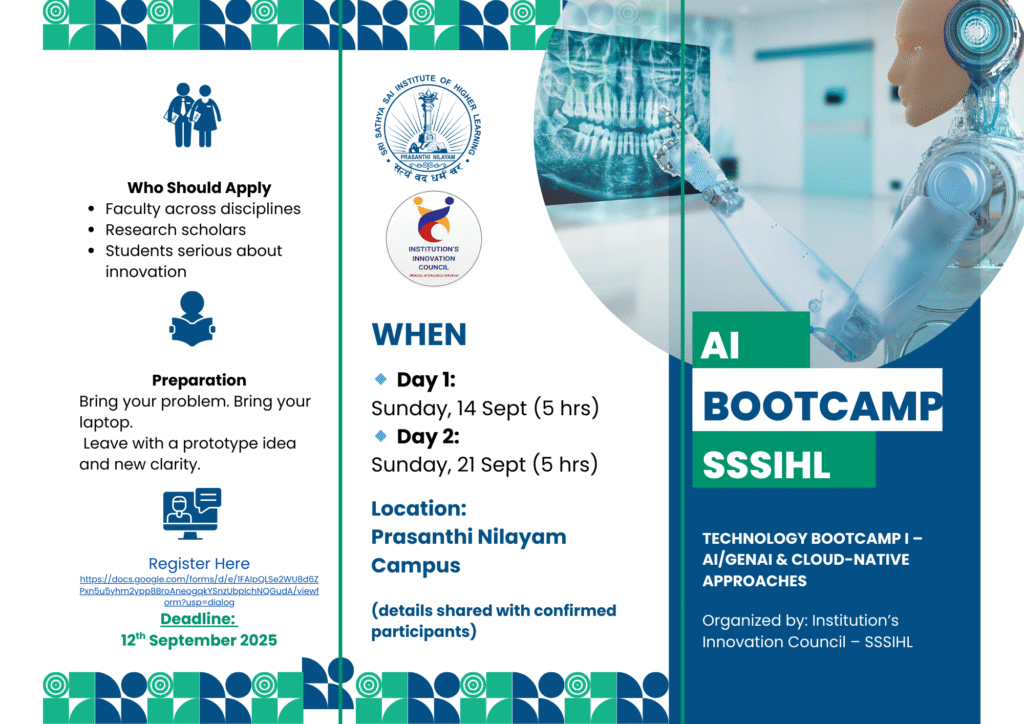
The AI Bootcamp at Sri Sathya Sai Institute of Higher Learning (SSSIHL), organized by the Institution’s Innovation Council, is a focused capacity-building program aimed at faculty, research scholars, and students committed to advancing innovation through artificial intelligence. The two-day bootcamp (14th and 21st September 2025, Prasanthi Nilayam Campus) provides participants with practical exposure to emerging technologies in Artificial Intelligence, Generative AI, and Cloud-Native approaches.
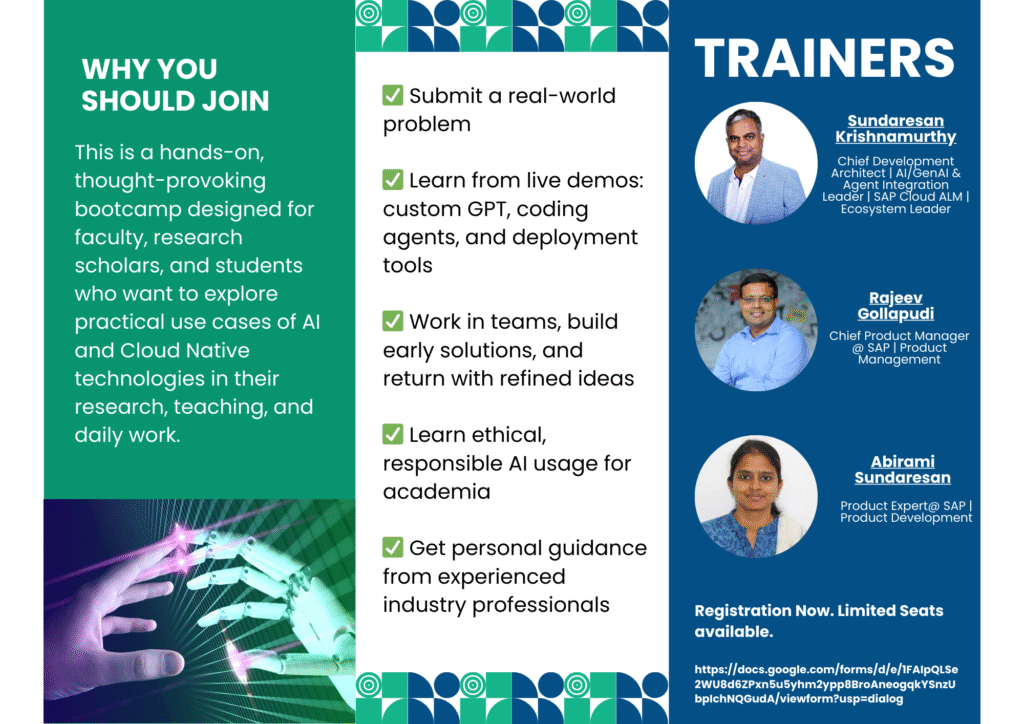
Structured around problem-driven learning, the program enables participants to bring real-world challenges, engage in live demonstrations of custom GPT models, coding agents, and deployment tools, and collaborate in teams to design early-stage prototype solutions. The bootcamp emphasizes ethical and responsible AI practices, particularly in the academic context, while fostering critical thinking and innovation.
Guided by expert trainers from SAP — Sundaresan Krishnamurthy (Chief Development Architect, AI/GenAI), Rajeev Gollapudi (Chief Product Manager), and Abirami Sundaresan (Product Expert) — participants will gain actionable skills, mentorship, and clarity to integrate AI-driven methods into research, teaching, and professional practice.
-
Day 1: Sunday, 14th September 2025 – 5 hours
-
Day 2: Sunday, 21st September 2025 – 5 hours
📍 Location: Prasanthi Nilayam Campus (detailed schedule to be shared with confirmed participants)
Crafting Your Winning Value Proposition: The Blueprint for Business Success by Dr.L Ganesh Kumar
In today’s fast-moving marketplace, building a great product or service is just the starting point. The real challenge lies in answering one critical question: “Why should customers choose you over anyone else?”
The answer lies in a compelling value proposition—a clear statement that explains how your product solves problems, delivers benefits, and sets you apart. Drawing insights from Dr. L. Ganesh Kumar’s session at SparkLab 2.0, let’s explore how to define, design, and deliver value that resonates with your audience and drives growth.
What Exactly is “Value”? It’s More Than You Think
Before we talk propositions, let’s break down “value.”
Value isn’t just about price—it’s shaped by context, behavior, and perception. Some key dimensions include:
- Usefulness & Availability: How helpful is it, and how easily can people access it?
- Time & Situation: Context matters. For example, Swiggy and Zomato became indispensable during COVID-19, while ventilators and oxygen gained unparalleled value during the second wave.
- Cost vs. Worth: What people pay versus what they feel it’s worth.
- Cultural, Behavioral & Psychological Factors: Our habits, emotions, and lifestyles strongly influence what we perceive as valuable.
At its core, value is about maximizing results while balancing cost and benefits. Think of it as:
👉 Value = Results ÷ Cost
The Three Pillars of a Strong Value Proposition
According to Dr. Ganesh Kumar, every winning value proposition rests on three pillars:
- Define the Proposition: Ask tough questions. Who is your buyer? Why do they need it? Is it affordable? Which segment are you targeting? Is it a “must-have” now or in the future? Clarity here is non-negotiable.
- Design the Value: Building on definition, you need the right skills, ecosystem, and strategy to create value that can actually be delivered.
- Deliver the Value: Execution is everything. Consistently delivering on your promise builds trust, credibility, and a stronger brand image.
So, What Is a Value Proposition?
Simply put:
A value proposition is a concise statement that explains how your product or service solves a problem, delivers clear benefits, and differentiates you from competitors.
It’s not about technical features—it’s about the usefulness and tangible benefits customers experience. Without clarity here, selling becomes an uphill battle.
Frameworks to Help You Craft Your Proposition
Several proven tools can sharpen your thinking:
- Value Proposition Canvas: The most widely used, with two parts:
- Customer Profile – Jobs (needs), Pains (obstacles), Gains (aspirations).
- Value Map – Products/services, Pain Relievers, Gain Creators.
The magic lies in achieving a strong fit between the two.
- Jobs to Be Done: Focuses on the “job” customers are hiring your product to do.
- The “So What?” Approach: Keep asking “so what?” until you uncover the emotional core of value.
- One-Sentence Pitch Formula: A concise template to define your offering in seconds.
Tailoring Value Propositions to Customer Profiles
A rookie mistake is creating a single value proposition for the entire company. Instead, craft specific propositions for different customer personas.
Tesla, for example, studied customer needs (appearance, transport), pains (accidents, safety), and gains (speed, design, cost-effectiveness) to map their offerings. The result? A value proposition that felt tailored and compelling.
Differentiation & Storytelling: Your Secret Weapons
A strong value proposition isn’t just about being different—it’s about telling why you matter. This means:
- Differentiation: Clearly state what sets you apart.
- Storytelling: Wrap your proposition in a narrative that connects emotionally.
Think about Sensodyne’s laser focus on pain relief, or a tea shop’s quirky “Chaijipati” during the ChatGPT craze. Stories grab attention and make benefits memorable.
From Value Proposition to Revenue & Valuation
A powerful value proposition translates into value-based selling—selling not just on features, but on perceived and real benefits.
If your value is clear, customers chase you (not the other way around). That pull directly impacts revenue and business valuation, making you more attractive to investors who seek scalable, high-return models.
Brand Identity & Credibility
Your value proposition is inseparable from your brand. Trust, dependability, and customer experience shape how your brand is perceived.
Dr. Ganesh Kumar puts it best:
“Practice values, create value, and be valuable.”
Protecting your brand’s integrity and value statement is just as important as creating it.
Iteration: The Hidden Ingredient
A winning value proposition is never static. It requires constant testing, refining, and rework. Founders must be fully convinced of their value before they can persuade others.
Overcoming Common Challenges
- External Pain Relievers: Only include them if they directly solve a customer’s problem and create demand for your product.
- Composite Offers: Avoid being too broad. Tailor propositions to specific personas for stronger emotional connection.
- Freemium Dilemma: Limited free versions may frustrate customers if not communicated well. Messaging is key to ensuring perceived value.
Your Next Step: Craft, Test, Refine
The Value Proposition Canvas is a powerful place to start. Map customer jobs, pains, and gains, then align your product’s pain relievers and gain creators.
When your proposition is precise, compelling, and tested, it fuels not only better market fit but also revenue growth and investor confidence.
Read MoreDesigning and Defining Value: How Clarity Drives Business Valuation by Dr. Ganesh Kumar
In today’s hypercompetitive world, success doesn’t just depend on having a good idea or a superior product. It depends on how clearly you define, design, and deliver value. This was the central theme of the Spark Lab 2.0 session on Designing and Defining Value Proposition, led by Dr. L. Ganesh Kumar, CEO of iFocus Syntec India Pvt. Ltd.
What Does “Value” Really Mean?
Value is at the heart of every ecosystem. It is shaped by the balance between need and affordability, as well as by culture, behavior, and lifestyle. A product can be highly needed but unaffordable—or affordable but irrelevant.
Take the example of Swiggy and Zomato. During COVID, their value skyrocketed when going out wasn’t possible. What began as a situational need turned into a post-COVID lifestyle habit.
According to Dr. Ganesh Kumar, six elements make up value:
- Usefulness
- Availability
- Time required to create and deliver
- Situation and location
- Cost and worth
- Behavioral and psychological aspects
In simple terms, Value = Result ÷ Cost. The higher the result and the lower the cost, the greater the value.
On a personal level, value can be measured by asking: Am I chasing others, or are others chasing me for my knowledge and skills? If others are chasing you, you are creating value.
The Three Pillars of Value Creation
Businesses must approach value creation in three stages:
1. Defining the Value
This is the most intellectually demanding stage. It requires answering questions like:
- Who is the buyer?
- Why do they need this?
- Is it affordable?
- Is it “must-have” or “nice-to-have”?
- Which segment does it target?
2. Designing the Value
Design depends on the organization’s capabilities and ecosystem. Companies must be able to scale fast when demand rises. For example, during COVID, ventilator manufacturers that could scale quickly succeeded.
3. Delivering the Value
Delivery is where customer experience and credibility are built. This is why customers prefer trusted brands—like Bosch washing machines—over generic ones, even at a higher cost.
Crafting a Clear Value Proposition
A value proposition is not jargon. It is a crisp statement that tells customers:
- How your product solves their problem.
- The exact benefits it provides.
- Why they should choose you over competitors.
Startups often struggle here, focusing too much on technology (“We use AI and blockchain”) rather than real usefulness (“It’s reliable, affordable, and comes with a warranty”).
Tools for Defining Value
Two frameworks stand out:
- Value Proposition Canvas: Map customer jobs, pains, and gains against your products, pain relievers, and gain creators. Importantly, make separate profiles for different roles (CFO vs. CTO vs. CHRO). The goal is to achieve perfect fitment between customer needs and your offering.
- “So What?” Framework: Keep asking So what? about every feature until you reach an emotional benefit. Example: We have 20 years of experience. So what? → It safeguards your data so you can rest easy.
From Value to Revenue
A great value proposition must translate into sales and revenue.
Perceived value often trumps economic value—that’s why customers pay more for a known brand. But the true test of value creation is simple: Is your revenue growing?
As Dr. Kumar emphasizes:
“If you’re creating one of the best value products or services, but there is no buyer and no revenue, then that value has no meaning.”
Strong revenue growth also fuels business valuation, reassuring investors of potential high returns.
The Unique Value Proposition (UVP)
Your UVP is the one sentence that makes customers say: Yes, this is why I should choose you.
To build a UVP:
- Study the competition with SWOT analysis.
- Highlight what makes you different.
- Tell a compelling story.
Above all, keep it simple, clear, and concise. A UVP must grab attention instantly and evolve through testing and refinement.
Linking Value to Brand Identity
A company’s value proposition directly shapes its brand. Building a valuable brand requires three practices:
- Practice Values – Build credibility and trust.
- Create Value – Offer products/services that solve real problems.
- Be Valuable – Ensure demand is strong and growing.
Defining value is not about buzzwords—it’s about clarity. A well-crafted value proposition drives revenue, strengthens brand identity, and ensures long-term business valuation.
Read More