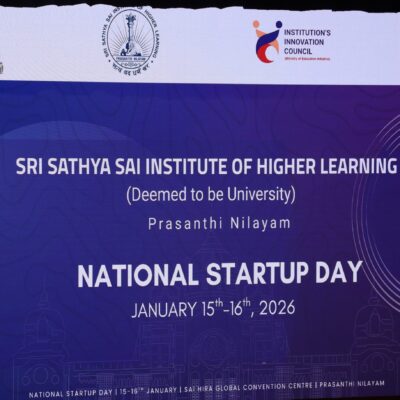
National Start-up Day 2026 : Inaugural Address Summary
Prof. B. Raghavendra Prasad, Vice Chancellor, Sri Sathya Sai Institute of Higher Learning
Prof. B. Raghavendra Prasad’s address on National Startup Day (15–16 January) set the intellectual and ethical tone for the two-day engagement, positioning innovation and entrepreneurship not as standalone pursuits, but as natural outcomes of a deeper educational philosophy. Speaking as both an academic leader and a scientist with decades of experience in advanced research ecosystems, he framed the event as a celebration of innovation rooted in purpose, responsibility, and service to society.
He began by situating the occasion within the spiritual and institutional ethos of Sri Sathya Sai Institute of Higher Learning (SSSIHL), recalling the founding vision of the institution—education that transforms the intellect, ennobles the heart, and empowers individuals to serve selflessly. This vision, he emphasized, is not symbolic but operational. Every academic, research, and entrepreneurial initiative at SSSIHL is designed to translate knowledge into societal good. In this context, National Startup Day was not merely commemorative; it was a reaffirmation of the Institute’s long-standing commitment to application-oriented learning and value-driven innovation.
Placing SSSIHL within the broader national landscape, Prof. Prasad drew clear alignment between the institution’s philosophy and India’s contemporary policy framework. He referenced key Government of India initiatives such as Startup India, Atmanirbhar Bharat, Make in India, and the National Education Policy 2020. Collectively, these initiatives aim to transform India into a knowledge-driven, innovation-led economy, with higher education institutions acting as catalytic hubs where teaching, research, and entrepreneurship intersect. According to Prof. Prasad, SSSIHL views this mandate not as a policy obligation but as a natural extension of its founding ideals—where learning must culminate in action, and action must serve national and societal priorities.
A central theme of his address was the shift from employment-seeking to employment-creating mindsets among India’s youth. Long before this became a national narrative, he noted, the institution’s founder consistently emphasized that students must emerge as job providers rather than job seekers. Today, with India witnessing a reversal of historic brain drain and a surge in domestic opportunities, this philosophy has gained renewed relevance. Prof. Prasad highlighted that the current ecosystem empowers students not only to aspire for meaningful roles but to create them—designing solutions, building enterprises, and recruiting talent aligned with their vision.
He then offered a detailed overview of SSSIHL’s innovation ecosystem, anchored by two complementary pillars: the Institution’s Innovation Council (IIC) and the Sri Sathya Sai Research and Innovation Foundation (SSSRIF). Together, these entities operationalize the Institute’s approach to entrepreneurship by integrating awareness, ideation, mentoring, research translation, and commercialization into a unified framework.
The Institution’s Innovation Council, he explained, functions as the primary engagement platform for students across disciplines. Its activities include structured awareness programs on innovation and startups, ideation workshops, boot camps, hackathons, and idea challenges aligned with the Startup India framework. A distinctive strength of the IIC lies in its interdisciplinary orientation—bringing together students from science, management, humanities, and technology to collaborate on real-world problems. This cross-pollination, Prof. Prasad noted, is critical for developing solutions that are technically sound, market-aware, and socially relevant.
Mentorship forms another core dimension of the IIC’s work. Industry experts, startup founders, alumni, and ecosystem partners actively guide students, helping them refine ideas, understand market realities, and navigate the early stages of venture creation. Importantly, the Council emphasizes experiential learning—encouraging proof-of-concepts, prototypes, and minimum viable products (MVPs). Through this hands-on exposure, students internalize that innovation is not defined by disruption or valuation alone, but by relevance, responsibility, and impact.
Complementing the IIC is the Sri Sathya Sai Research and Innovation Foundation, a Section 8 company supported by the broader Sri Sathya Sai institutional ecosystem. Prof. Prasad highlighted its role in advancing faculty- and student-driven research with strong translational and startup potential. The Foundation actively supports intellectual property creation, including invention disclosures, patents, and technology transfers, while encouraging deep-tech and research-led startups aligned with national priorities such as Atmanirbhar Bharat.
He underscored that SSSRIF’s work extends beyond commercialization. By enabling collaborations with industry, government agencies, and national research missions, the Foundation ensures that innovation at SSSIHL remains connected to real-world needs. Strategic focus areas include healthcare technologies, sustainability, advanced materials, data sciences, and agri-tech—domains where scientific advancement can directly enhance societal well-being. Across these efforts, Prof. Prasad stressed that ethical grounding, inclusiveness, and human welfare remain non-negotiable principles guiding technological progress.
Reflecting on the Institute’s startup culture, he described it as fundamentally value-centric. Startups emerging from SSSIHL are expected to be professionally competent and intellectually rigorous, yet equally ethical, socially conscious, and compassionate in action. Economic growth, in this framework, is not an end in itself but a means to achieving social harmony, environmental sustainability, and national well-being. This perspective distinguishes SSSIHL’s entrepreneurial ecosystem from purely market-driven models and reinforces its role as a responsible contributor to India’s innovation landscape.
Addressing students directly, Prof. Prasad spoke of the unprecedented opportunities characterizing the current era. Drawing from his own academic journey, he contrasted earlier periods—when limited domestic opportunities forced many talented individuals abroad—with today’s environment, where students can create pathways aligned with their capabilities and aspirations. At SSSIHL, he assured, no idea goes unheard. Every concept is given due consideration, refined where necessary, and supported through mentorship and institutional mechanisms to improve its viability and impact.
In this context, he encouraged students to actively engage with upcoming platforms that translate ideas into action. Initiatives such as the forthcoming Megathon were positioned as critical opportunities for students to test their thinking, collaborate across disciplines, and experience the rigour of problem-solving under real constraints. Participation, he implied, is not merely about competition but about immersion—learning how innovation evolves from insight to implementation within a supportive ecosystem.
Concluding his address, Prof. Prasad expressed appreciation for faculty members, innovation leaders, mentors, alumni, and students who continuously strengthen the Institute’s entrepreneurial environment. He articulated a clear aspiration: that SSSIHL’s startup and innovation ecosystem should evolve into a role model for the country, much like its academic programs. With innovation serving humanity, research addressing national priorities, and entrepreneurship guided by enduring values, he envisioned the institution as a beacon of hope within India’s broader startup ecosystem.
His address effectively framed National Startup Day not as an isolated celebration, but as a reaffirmation of SSSIHL’s integrated approach to education, research, and entrepreneurship—an approach where innovation is purposeful, entrepreneurship is responsible, and participation in initiatives like the upcoming Megathon becomes a meaningful step toward nation-building.
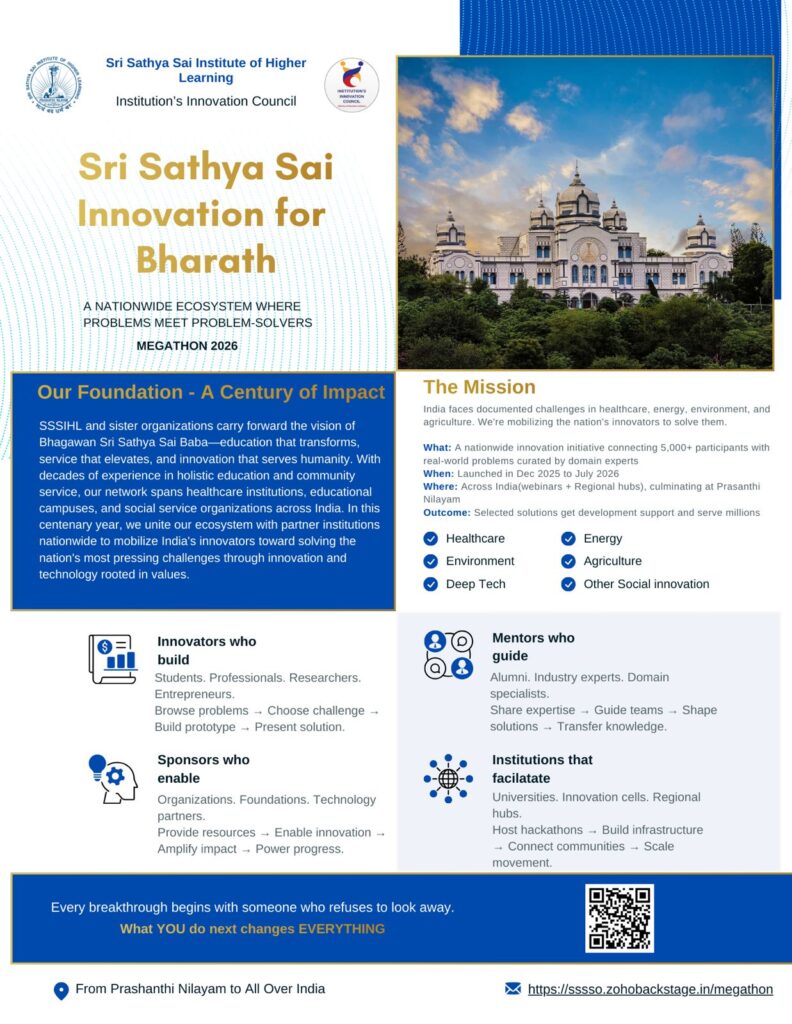
Want to Be Part of India’s Next Big Innovation Movement?
Join Sri Sathya Sai Innovation for Bharat – MEGATHON 2026, a nationwide platform bringing together innovators, mentors, and knowledge partners to solve real-world challenges.
Focus Areas: Healthcare | Energy | Environment | Agriculture | Deep Tech
🗓 December 2025 – June 2026
⭐ 100% Free Registration (All Categories)
More than a competition—this is innovation with purpose.
👉 Register here:
https://sssso.zohobackstage.in/megathon
📩 Queries: [email protected]
Megathon SSSIHL Innovation