
National Start-up Day 2026 : Chief Guest Address Summary
Dr. Sethuraman Panchanathan
Former Director, U.S. National Science Foundation | University Professor of Technology and Innovation, Arizona State University | Padma Shri Awardee (2025)
Dr. Sethuraman Panchanathan’s address stood out as a deeply experiential, insight-driven exposition on what it truly means to cultivate an entrepreneurial mindset—moving far beyond the narrow definition of startups and venture creation. Drawing from his global leadership experience across academia, national science policy, and innovation ecosystems, he positioned entrepreneurship as a fundamental human capability rooted in curiosity, exploration, and responsibility.
He began by affirming the collective role of institutions, faculty, alumni, and students in shaping outcomes larger than individual success. Emphasizing that transformative change is never the result of isolated brilliance, he underscored the idea that purpose flows through people differently—but with equal potential. This framing established a powerful premise: entrepreneurship is not reserved for a gifted few; it is embedded in everyone and must be consciously nurtured.
To illustrate this, Dr. Panchanathan traced the origins of entrepreneurship to human curiosity itself. From infancy, he explained, exploration defines how individuals interact with the world—touching, observing, questioning, and learning. This exploratory instinct, he argued, is the foundation of the entrepreneurial mindset. The responsibility of educational institutions, therefore, is not to manufacture entrepreneurs artificially, but to protect, cultivate, and channel this innate curiosity into meaningful problem-solving.
He reinforced this argument through a compelling example from his time at Arizona State University, where he helped create an initiative designed to enable students to work collaboratively on problems they genuinely cared about. The emphasis was not on credentials or hierarchy, but on self-assembled, interdisciplinary teams. He recounted how a simple concern expressed by a student—feeling unsafe while commuting on campus—became the starting point for an innovative solution. Undergraduate students from electrical engineering, computer science, mechanical engineering, design, and public policy came together to conceptualize, design, regulate, and prototype a drone-based safety escort system. The success of this project, he noted, did not lie merely in the technology, but in the process: curiosity-led problem identification, interdisciplinary collaboration, regulatory awareness, and sustained execution.
From this narrative, Dr. Panchanathan distilled a critical insight: entrepreneurial capability is not domain-specific. Engineers, designers, policymakers, and researchers all contribute uniquely when the environment allows them to do so. More importantly, such innovation ecosystems must be accessible to all students—not just those who self-identify as entrepreneurs.
Turning his focus to curriculum and institutional responsibility, he urged academic leaders to integrate entrepreneurial mindset training across disciplines. He clarified that this does not imply that every student must start a company. Rather, entrepreneurial thinking enhances professional effectiveness across roles—producing better engineers, better policymakers, better designers, and more adaptive leaders, especially in an era increasingly shaped by artificial intelligence. According to him, failing to explore this mindset during one’s academic journey represents a missed opportunity with long-term consequences.
A central highlight of his address was a structured framework he referred to as the “Ten I’s” of entrepreneurship—a practical roadmap for translating ideas into impact. The first, he explained, is Idea. Every entrepreneurial journey begins with an idea, often emerging spontaneously from daily life. However, excitement alone is insufficient. The second “I” is Innovation, which requires validating whether the idea is genuinely novel. In today’s context, he noted, tools such as AI platforms can assist in quickly assessing whether similar solutions already exist.
Yet, novelty alone does not justify venture creation. This led to the third “I”: Impact. Dr. Panchanathan was explicit in cautioning against equating academic success—such as publications or patents—with startup viability. Through a candid personal anecdote involving his own NSF-funded research idea, he described how rigorous customer discovery processes revealed uncomfortable truths about market relevance. Participation in structured programs such as the NSF Innovation Corps and lean launchpad models forced him to confront the gap between technical merit and real-world value. This humbling experience, he emphasized, is essential for any aspiring entrepreneur.
Once impact is validated, the next step is Implementation. Ideas that remain theoretical or confined to paper have limited value in entrepreneurial contexts. Creating prototypes and minimum viable products (MVPs) is non-negotiable. He reminded the audience that implementation does not require perfection; it requires commitment to learning through building.
However, implementation is impossible without Infrastructure, the fifth “I”. Dr. Panchanathan highlighted how access to institutional resources—labs, fabrication spaces, computing facilities, research centers, and domain-specific infrastructure—can dramatically lower barriers to innovation. He acknowledged that students at Sri Sathya Sai Institute of Higher Learning are uniquely positioned due to the presence of structured support systems such as the Institution’s Innovation Council and the research and innovation foundation.
The sixth “I,” Immediacy, addressed the importance of speed. In startup ecosystems, time is a competitive variable. Ideas lose relevance if execution is delayed. He cautioned against prolonged perfectionism, stressing the need to act decisively while learning iteratively.
Closely related is the seventh “I,” Intensity. Entrepreneurship, he asserted, is not a part-time endeavor. Whether undertaken by students or faculty, it demands sustained focus, energy, and intentional effort. Without intensity, even well-funded and well-conceived ideas falter.
The eighth “I,” Investment, broadened the conversation to funding pathways. Drawing from his experience at the U.S. National Science Foundation, Dr. Panchanathan illustrated how public funding mechanisms such as SBIR and STTR programs have historically seeded transformative companies—citing examples such as Google, Qualcomm, and leading synthetic biology firms. He emphasized that investment can come from multiple sources: governments, institutions, angel investors, and venture capital. Awareness of these pathways is as important as technical competence.
The ninth “I” focused on India’s Moment. He contextualized entrepreneurship within India’s national trajectory, referencing the country’s rapid rise in global startup growth and the broader vision of long-term national development. He highlighted the increasing emphasis on job creation rather than job acquisition, noting that this shift represents a structural opportunity for India’s youth. State-level visions, including ambitious goals of fostering entrepreneurship at the household level, further reinforce this momentum.
The final “I” was Immersion, which he described as uniquely powerful at Sri Sathya Sai Institute of Higher Learning. He pointed to the institution’s value-driven legacy, rural context, integrated ecosystem of hospitals, universities, and community projects, and the profound opportunity this creates for identifying underserved problems in health, education, sustainability, and social development. This immersion, he argued, provides a living laboratory for socially relevant innovation rarely available elsewhere.
Throughout his address, Dr. Panchanathan repeatedly returned to a central theme: belief. Transformational outcomes emerge when students and faculty believe in their capacity to act, apply themselves with discipline, and follow structured pathways from idea to impact. He reinforced this through global examples of NSF-funded innovations that evolved into multi-billion-dollar enterprises and life-changing technologies—outcomes that began with students and early-career researchers willing to test their ideas.
He concluded by bringing the message back to the present context, encouraging students to actively engage with institutional platforms such as the Institution’s Innovation Council and upcoming initiatives like the Megathon. Such forums, he noted, are not merely competitive events but accelerators of mindset—spaces where curiosity, collaboration, speed, and responsibility converge. Participation in these initiatives is a concrete way for students to translate inspiration into action.
Dr. Panchanathan’s address ultimately reframed entrepreneurship as a disciplined expression of human potential—grounded in curiosity, sharpened by validation, enabled by infrastructure, and guided by values. His message was clear: the moment is now, the ecosystem is ready, and the responsibility to act rests with each individual willing to explore, build, and serve.
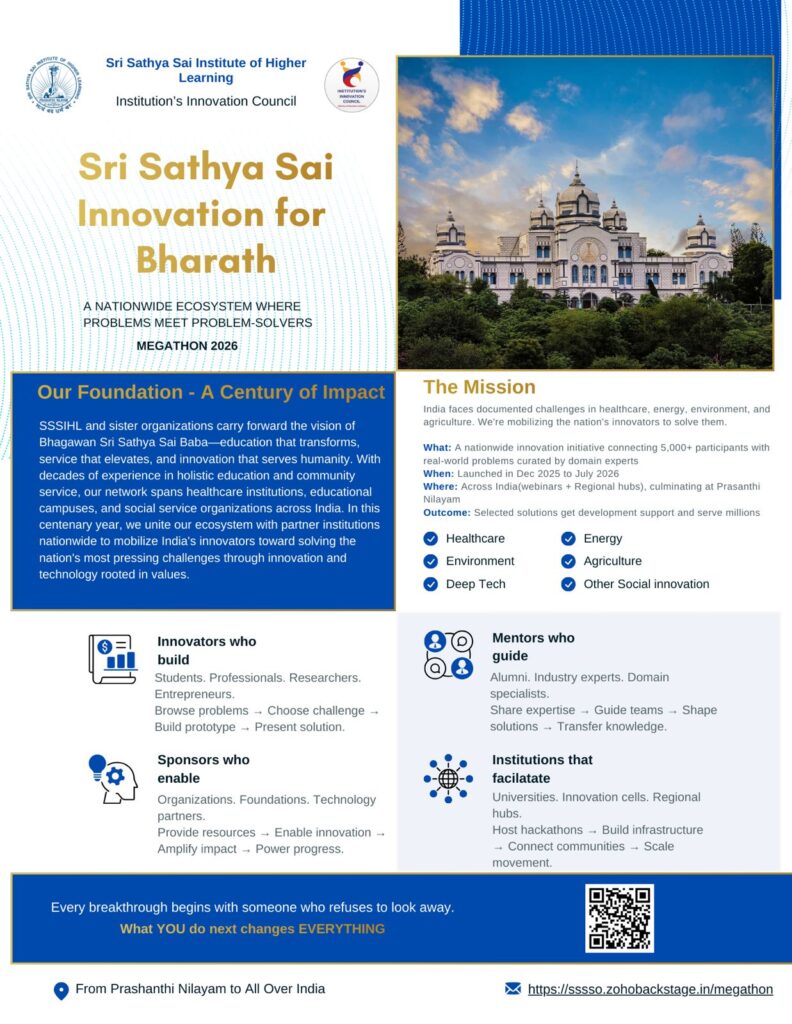
Want to Be Part of India’s Next Big Innovation Movement?
Join Sri Sathya Sai Innovation for Bharat – MEGATHON 2026, a nationwide platform bringing together innovators, mentors, and knowledge partners to solve real-world challenges.
Focus Areas: Healthcare | Energy | Environment | Agriculture | Deep Tech
🗓 December 2025 – June 2026
⭐ 100% Free Registration (All Categories)
More than a competition—this is innovation with purpose.
👉 Register here:
https://sssso.zohobackstage.in/megathon
📩 Queries: [email protected]
Megathon SSSIHL Innovation