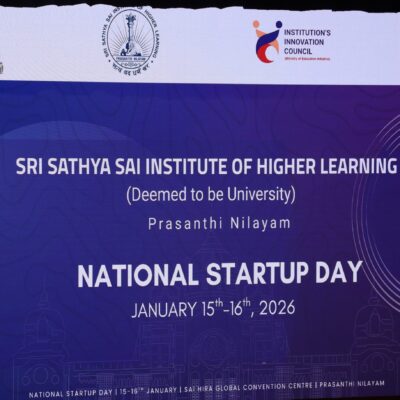
National Start-up Day 2026 : Alumni Panel Discussion Summary
Topic: One Size Doesn’t Fit All: Innovation and Entrepreneurship Models in Academic Setups
The Alumni Panel Discussion brought a grounded, experience-led dimension to National Startup Day by dismantling one of the most persistent myths surrounding entrepreneurship—that there is a single, linear path to innovation and success. Through diverse lived experiences across healthcare, education, corporate transformation, social enterprise, and innovation enablement, the panel demonstrated that entrepreneurship in academic ecosystems is plural, contextual, and deeply personal.
Moderated by Sai Sudha Nunna, Content Strategist and Consultant at 99italics Consulting, the session featured distinguished alumni representing distinct models of innovation:
- Malathi Srinivasan, Lead – Innovation Alliance, Pfizer
- Vinod Karthic, Managing Trustee, Sri Sai Krishna Charitable Trust
- Dr. Shefali Bharadwaj, Co-Founder, Happyfit
- Dr. Ramakrishnan R, Senior Faculty, School of Design Thinking
Together, they reframed innovation not as a race toward unicorn valuations, but as a spectrum of models shaped by purpose, capability, life stage, and societal need.
Breaking the Startup Stereotype
The discussion opened by challenging the dominant startup imagery—dropping out, building in garages, pitching to venture capitalists, and equating success with rapid scale. The moderator underscored that this narrative discourages many capable students from engaging with entrepreneurship at all. The panel’s collective intent was to dismantle this narrow framing and replace it with realistic, inclusive pathways.
Each panelist embodied a different entrepreneurial archetype: the service-based bootstrapper, the infrastructure-heavy social institution builder, the corporate intrapreneur, and the ecosystem enabler. This diversity itself became the central message—innovation does not demand uniformity.
Choosing the Right Model: Self-Awareness Before Scale
Dr. Shefali Bharadwaj articulated a model rooted in depth, credibility, and personal alignment. After over a decade of experience in food science, nutrition technology, and behavioral health, she consciously chose a bootstrapped, service-oriented entrepreneurship model. For her, success depended less on speed and more on trust, empathy, and sustained impact.
She highlighted that people-facing businesses—particularly in health and behavior change—cannot be rushed without diluting outcomes. Scaling prematurely risks losing the very essence of transformation. Her approach emphasized building strong foundations before expansion and designing a venture that evolves with life stages rather than against them.
A critical insight she offered was the need for guided inner exploration at the university level. Tools such as aptitude assessments, personality mapping, and reflective exercises could help students identify what they are naturally inclined toward—front-end engagement, backend systems, or strategic design—thereby accelerating clarity and reducing years of trial-and-error.
Infrastructure-Heavy Models and the Role of Trust
Vinod Karthic presented a contrasting model—one deeply embedded in infrastructure, governance, and community engagement. Building schools, healthcare programs, and skilling initiatives across villages requires credibility, regulatory navigation, and sustained stakeholder trust.
He emphasized that in social entrepreneurship, purpose must remain higher than profit. Working with government bodies, parents, communities, and donors demands transparency and ethical consistency. Drawing from large-scale rural interventions—including crisis response during the COVID-19 pandemic—he reinforced that values, governance, and collaboration are not optional; they are operational necessities.
Importantly, he reframed entrepreneurship as working with money for something higher than money. This mindset, cultivated during his education, enabled him to sustain long-term initiatives even when progress was slow or outcomes were uncertain.
When Corporations Become Startups
Dr. Ramakrishnan R offered a compelling intrapreneurial perspective, illustrating how entrepreneurship is equally relevant within mature organizations. He recounted the transformation of a large, listed services company into a product-led global enterprise—an exercise that demanded vulnerability, risk-taking, and the courage to abandon established comfort zones.
This transition, he explained, mirrored startup dynamics in mindset if not in funding. Letting go of a stable “cash cow” to build proprietary intellectual property required leadership willing to embrace uncertainty. His experience highlighted that entrepreneurship is fundamentally about mindset, not company size.
He further emphasized that expertise can become a trap if it blinds innovators to real customer needs. Technology is not always the solution; sometimes, simpler systemic or logistical interventions create greater value. Understanding the human behind the problem is critical.
The Ecosystem Enabler’s Lens
Malathi Srinivasan brought a panoramic view from her work with incubators, research parks, and innovation alliances. She stressed that before dreaming of startups, students must address essential “checkpoints”: clarity of idea, risk appetite, competitive awareness, and long-term vision.
She observed that many early-stage founders struggle not because of weak ideas, but due to low resilience and an inability to absorb failure. In contrast, students from Sri Sathya Sai Institute of Higher Learning exhibit a distinctive strength—emotional resilience anchored in values. This, she noted, is a powerful competitive advantage that should be consciously leveraged rather than understated.
What Makes SSIHL Students Entrepreneurial?
A recurring theme was the institution’s self-reliance culture. From managing hostels and stores to participating in village service programs, students are exposed early to real-world systems. These experiences cultivate practical skills—logistics, budgeting, stakeholder management—that classrooms alone cannot teach.
The panel articulated a simple but powerful framework learned through service:
Listening, Observation, Research, and Dialogue—skills essential for customer discovery and problem-solving. These capabilities, developed organically through campus life, position students uniquely for entrepreneurship.
Defining Success Beyond Sustainability
When addressing venture success, the panel moved beyond financial metrics. Vinod Karthic summarized success as:
- Purpose over profit
- Mission over money
- Teams over titles
- Values over victory
This reframing resonated strongly across the discussion. Sustainable impact, ethical consistency, and long-term relevance were positioned as more meaningful indicators than short-term scale.
Dr. Shefali added that incubation must extend beyond ideas to incubating people—helping founders manage ego, self-doubt, comparison, pressure, and identity. Entrepreneurship demands inner resilience as much as external strategy.
Actionable Recommendations for Universities
The panel converged on several clear, implementable recommendations:
- Mandatory entrepreneurial mindset modules across disciplines
- Structured inner exploration and psychometric assessments
- Early exposure to regulatory and governance mentoring
- Safe spaces to test, fail fast, and redefine success
- Alumni-led mentoring with structured recognition and respect for time
These suggestions align closely with institutional platforms such as the Institution’s Innovation Council and ongoing initiatives designed to lower friction for student innovators.
From Insight to Action: The Megathon Opportunity
The session concluded with a strong call to action. Students were encouraged to identify one issue that genuinely disturbs them, articulate it in a single sentence, and take the first step toward validation. Platforms such as the upcoming Megathon were highlighted as practical entry points—spaces not just to compete, but to explore, collaborate, and learn within a supportive ecosystem.The emphasis was clear: participation is less about winning and more about beginning.
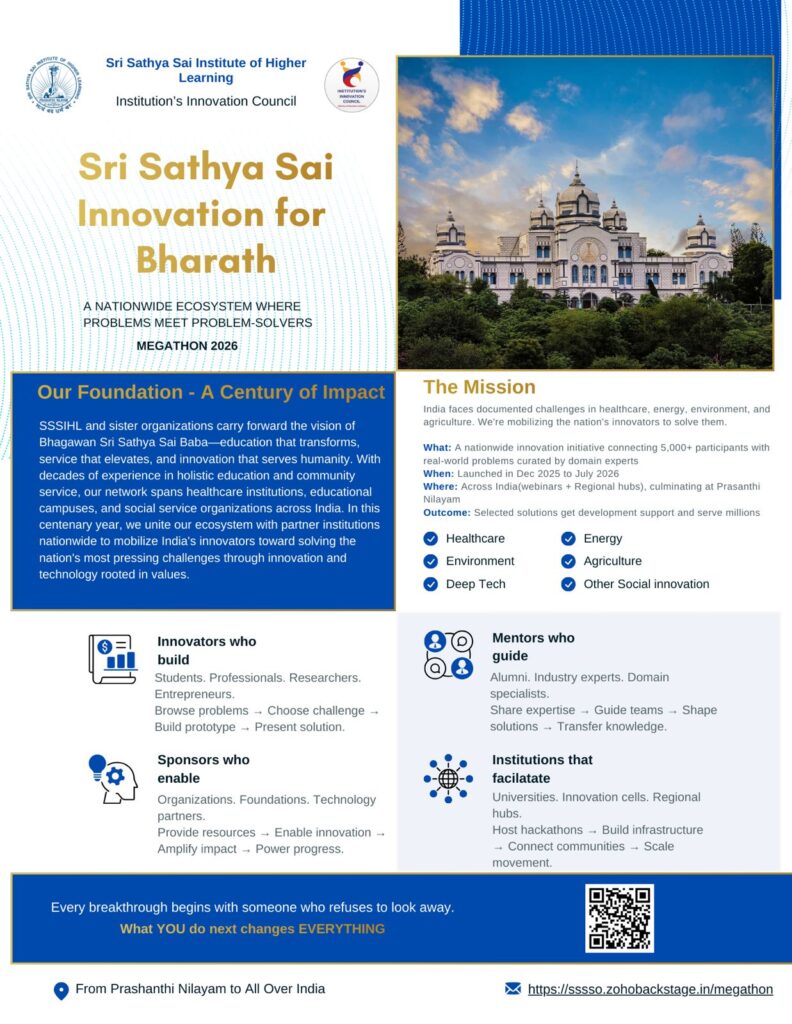
Want to Be Part of India’s Next Big Innovation Movement?
Join Sri Sathya Sai Innovation for Bharat – MEGATHON 2026, a nationwide platform bringing together innovators, mentors, and knowledge partners to solve real-world challenges.
Focus Areas: Healthcare | Energy | Environment | Agriculture | Deep Tech
🗓 December 2025 – June 2026
⭐ 100% Free Registration (All Categories)
More than a competition—this is innovation with purpose.
👉 Register here:
https://sssso.zohobackstage.in/megathon
📩 Queries: [email protected]
Megathon SSSIHL Innovation