
National Start-up Day 2026 : Expert Panel Discussion Summary
Topic: Research to Revenue – Challenges and Opportunities
The Expert Panel Discussion on “Research to Revenue – Challenges and Opportunities” addressed one of the most persistent gaps in India’s innovation ecosystem: the difficulty of translating high-quality research into scalable, revenue-generating solutions. Anchored in real-world entrepreneurial, corporate, and deep-tech experience, the session moved decisively beyond theory to examine why promising research often stalls—and what must change to unlock its commercial and societal value.
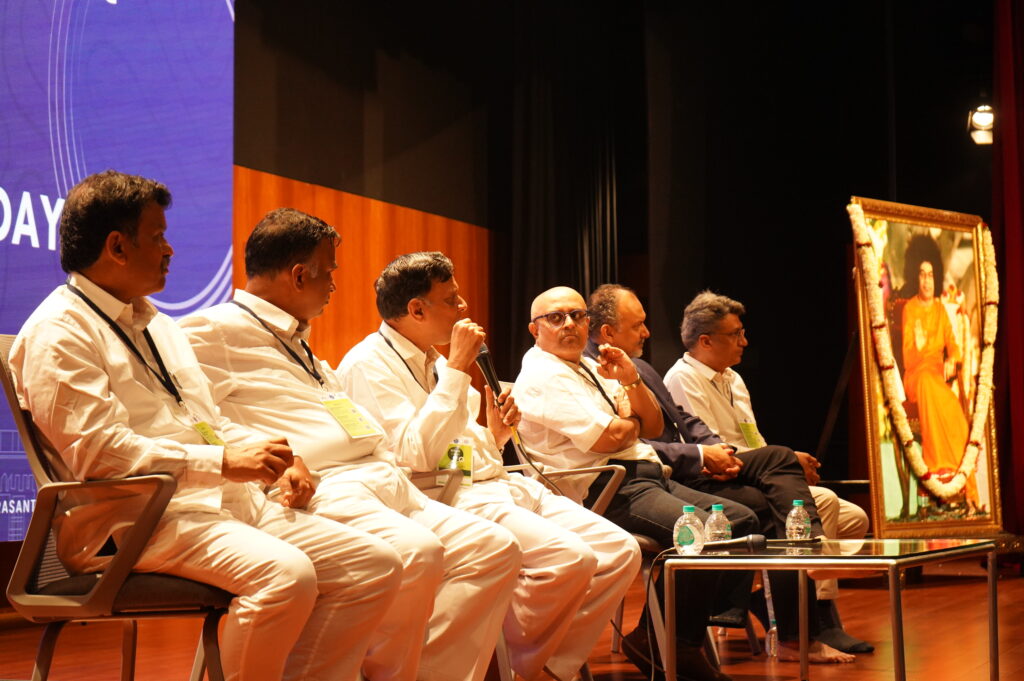
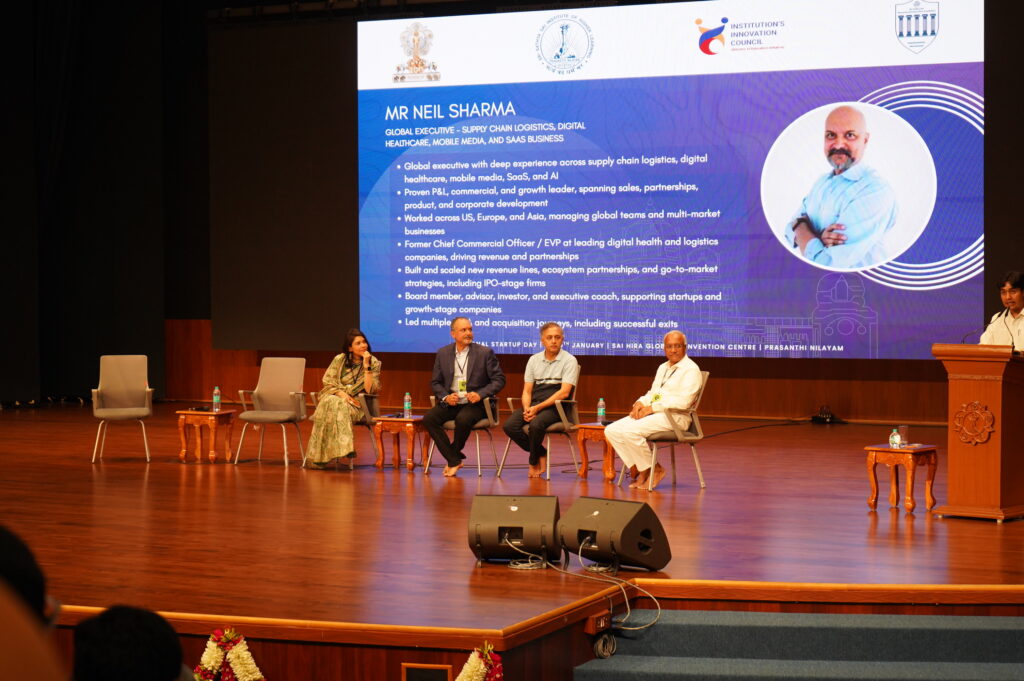
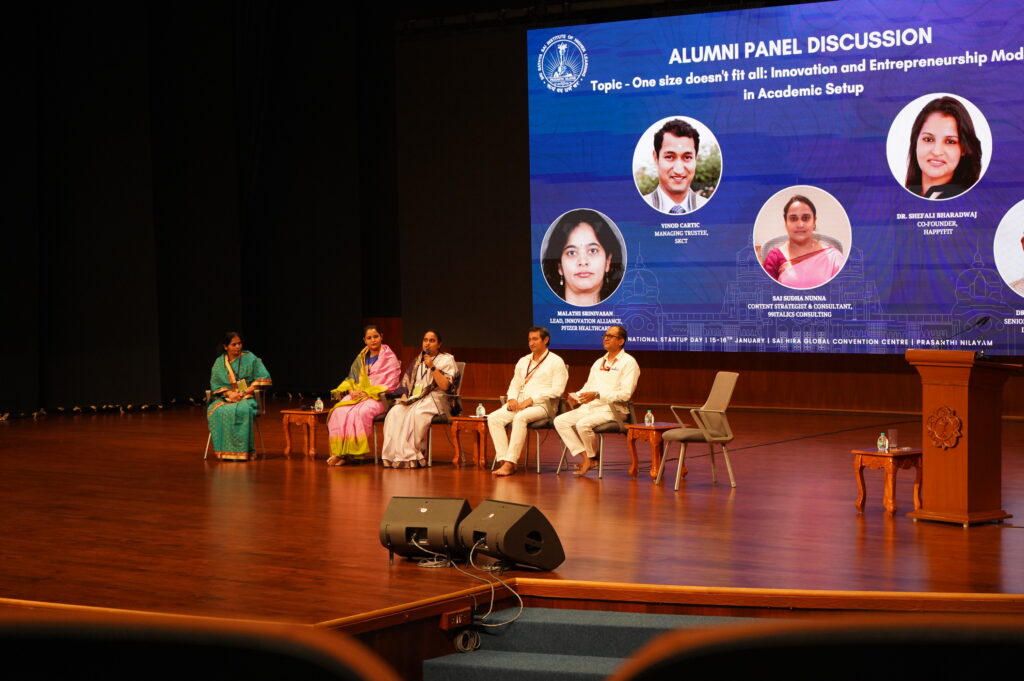
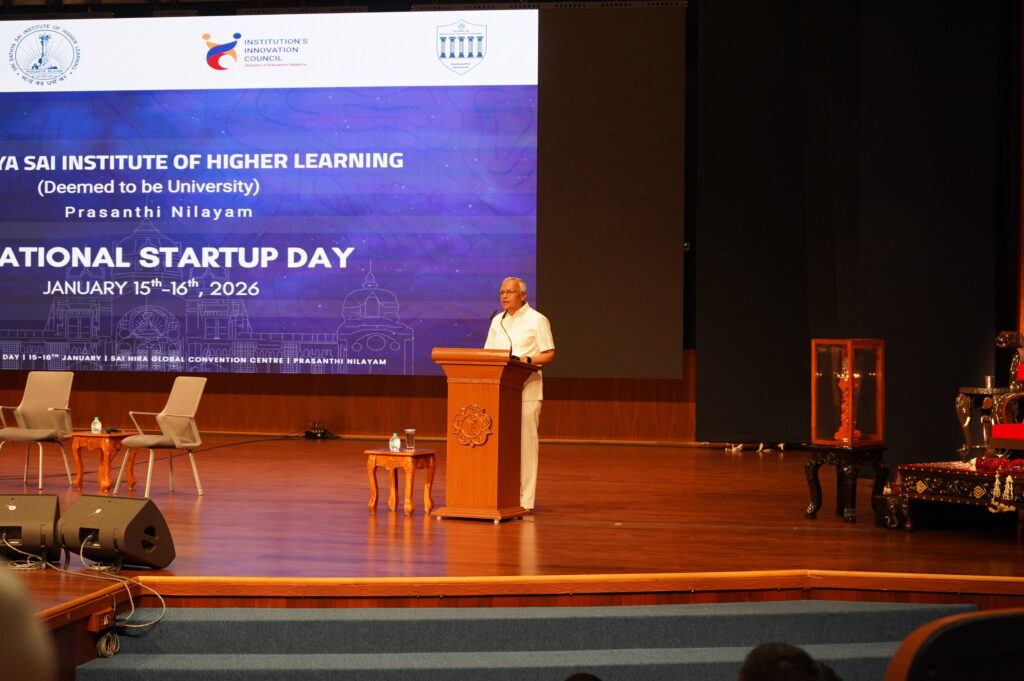
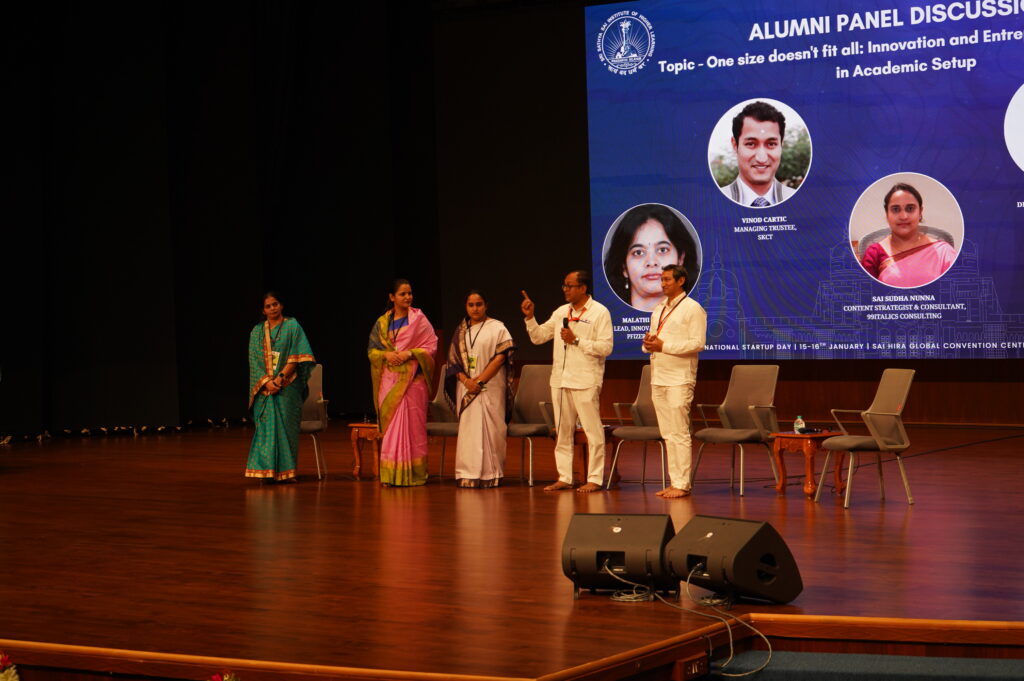
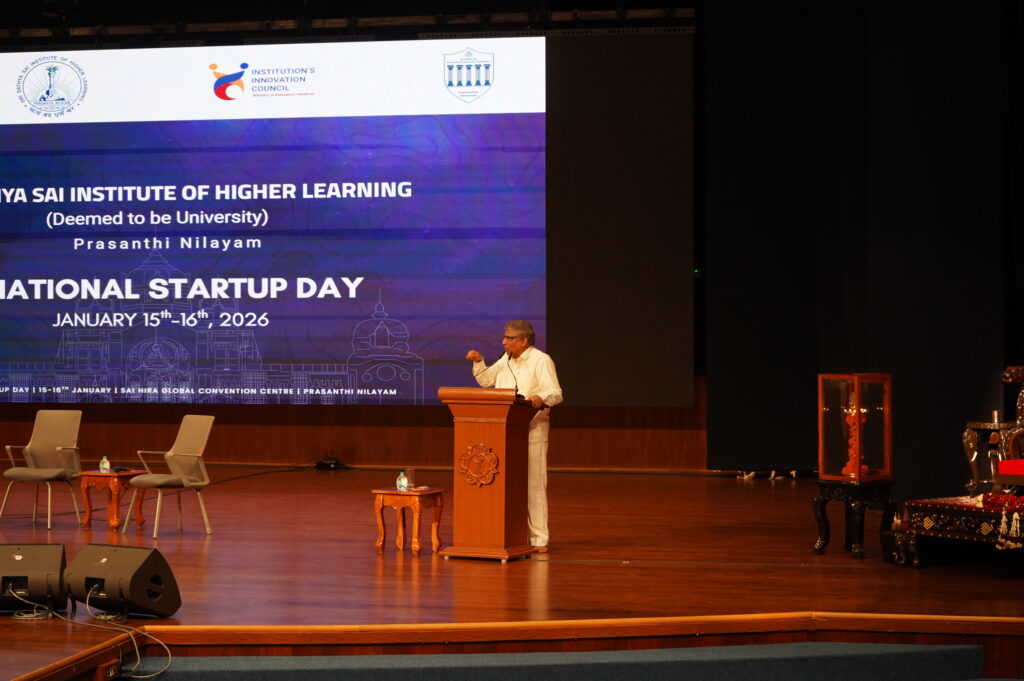
Moderated by NLS Murthy, General Manager at Greenway Health and a proud alumnus of Sri Sathya Sai Institute of Higher Learning, the panel brought together experts who have navigated the full spectrum—from academic research and deep-tech innovation to global consulting, venture scaling, and go-to-market execution.
The panelists included:
- Kamesh Krishnamoorthy, Co-Founder, Prospient Solutions Pvt. Ltd.
- Vandita Tiwari Kapoor, Founder & CEO, Iyurved
- Adithi Adhinachalam, Founder & CEO, Voxelgrids Innovations Private Limited
- Neil Sharma, Senior Partner, NCSP Supply Chain Experts
Together, they offered a candid, experience-driven exploration of how research ideas survive—or fail—the journey to revenue.

Setting the Context: Why Research Fails to Become Revenue
The discussion opened with a sobering reality: only a small fraction of global research converts into market-ready products, and India’s numbers, while improving, reflect a systemic challenge rather than an isolated failure. The issue, the moderator emphasized, is not a lack of intelligence or effort, but the absence of repeatable systems that connect research, validation, manufacturing, and markets.
Commercialization, the panel agreed, is not an event—it is a disciplined, multi-stage process requiring clarity of problem, differentiation, readiness assessment, and sustained execution.
Deep-Tech Reality: Long Horizons, High Conviction
Adithi Adhinachalam’s journey in building indigenous, low-cost MRI technology illustrated the unique challenges of deep-tech commercialization. Unlike digital startups, hardware and medical technology require long gestation periods, sustained funding, and extraordinary team resilience.
He highlighted three structural barriers that researchers often underestimate:
- Problem Exposure: Early-stage academic research often lacks proximity to real-world problems, leading to solutions without clear demand.
- Ecosystem Fragmentation: Isolated excellence does not translate into impact unless institutions, funders, and industry act in unison.
- Time Risk: Deep-tech ventures can take 10–15 years, making talent retention and morale as critical as funding.
A particularly insightful segment focused on intellectual property strategy. Filing patents, he cautioned, is not automatically protective. Enforceability, disclosure risks, litigation costs, and the ability to detect infringement must all be weighed. In many cases, strategic secrecy and execution speed may offer stronger protection than formal IP alone.
His core message was unequivocal: deep-tech founders must anchor themselves in purpose beyond personal gain. Without that, persistence over decades is nearly impossible.
Corporate Perspective: Innovation Begins with Unmet Needs
Drawing from decades of global consulting and enterprise scaling, Kamesh Krishnamoorthy reframed innovation through a corporate-commercial lens. He distinguished between incremental improvements and true innovation, emphasizing that revenue emerges when research addresses unmet or unknown needs, not when it refines what already exists.
He introduced a critical validation lens:
Can the customer afford to ignore your solution?
If the answer is yes, scalability will be limited—regardless of technical brilliance. He cautioned against overreliance on controlled research environments, where success metrics are forgiving and market realities are absent.
From his experience, failures often stem from:
- Weak problem definition
- Lack of early scale planning
- Technology-first thinking without customer urgency
He encouraged innovators to design for scale from day one—whether through cloud-native architectures, manufacturing efficiency, or ecosystem partnerships.
Research-Led Consumer Ventures: Where Market Research Goes Wrong
Vandita Tiwari Kapoor offered a grounded, practitioner’s view from the consumer health and nutrition space. Her insights were particularly relevant to early-stage founders navigating the “research-to-market” transition.
She identified three common mistakes that derail commercialization:
- Biased Market Research: Poorly designed questionnaires that validate moral correctness rather than real buying behavior.
- Wrong Respondent Pool: Surveying friends, family, or well-wishers instead of actual target customers.
- Misplaced Advice: Seeking guidance from people who have not built similar businesses, despite good intentions.
Her emphasis on customer intimacy was striking. True go-to-market clarity, she argued, emerges only when founders can describe their customer’s lifestyle, habits, language, spending patterns, and daily constraints with precision.
She urged students to avoid romanticizing funding narratives popularized by media platforms and instead focus on acquiring the first ten paying customers—a milestone that builds more credibility than any pitch deck.
Startup Scars and Founder Habits
Neil Sharma distilled his experience across startups, failures, acquisitions, and IPOs into a set of behavioral insights. He shifted the conversation from strategy to habits, asserting that commercialization success is often determined by founder behavior rather than idea quality.
Key habits he emphasized:
- Writing ideas down immediately to combat cognitive loss and false clarity
- Asking questions relentlessly to accelerate learning and calibration
- Collaborative mindset over individual brilliance
He cautioned strongly against surrounding oneself with “yes-people,” noting that early, constructive friction is often a signal that an idea is meaningful rather than flawed.
His broader message connected innovation to societal responsibility. Research-to-revenue journeys that ignore social relevance may succeed briefly but rarely leave a lasting legacy.
Readiness Frameworks: Beyond Technology Alone
A pivotal segment of the discussion centered on Readiness Levels, particularly in light of India’s recent formalization of Technology Readiness Assessments.
The panel expanded the conventional framework:
- TRL (Technology Readiness Level)
- MRL (Manufacturing Readiness Level)
- PRL (Product Readiness Level)
They introduced an additional, often overlooked dimension:
- DRL (Differentiation Readiness Level)
DRL forces innovators to answer a fundamental question: Why does this solution matter uniquely, and to whom? Without differentiation, even technically mature products struggle to attract funding or adoption.
The panel stressed that investors increasingly evaluate readiness holistically—across technology, manufacturability, market fit, and differentiation—rather than in isolation.
Funding Pathways: From Grants to Collaborative Commercialization
On funding, the panel outlined a pragmatic progression:
- Government Grants (early-stage validation and proof-of-concept)
- Angel Investment (early market traction and pilot scaling)
- Corporate Collaboration (pre-production, validation, and go-to-market support)
Rather than viewing corporates solely as funders, the panel encouraged positioning them as co-creators—sharing validation, infrastructure, and domain expertise through joint product councils and pilot programs.
This model reduces capital dependency while accelerating market learning—particularly relevant for institutions and startups emerging from academic ecosystems.
Action Framework: Stop, Start, Continue
In a closing rapid-fire round, panelists offered a clear behavioral roadmap for aspiring innovators:
Stop
- Overanalyzing and seeking excessive validation
- Surrounding yourself only with agreeable voices
- Fearing failure or reputational loss
Start
- Selling early—ideas, products, and even yourself
- Observing problems deeply without judgment
- Documenting insights consistently
Continue
- Practicing discipline and persistence
- Building expertise through sustained effort
- Anchoring innovation in societal purpose
A recurring emphasis was placed on sales as a core entrepreneurial skill—not as persuasion, but as structured learning from real markets.
Institutional Takeaway and the Megathon Imperative
The discussion reinforced that Sri Sathya Sai Institute of Higher Learning already possesses a rare convergence of assets—research depth, innovation platforms, hospital integration, and mentoring ecosystems. The remaining gap is participation and execution.
Platforms such as the upcoming Megathon were highlighted as critical bridges—spaces where research ideas can be stress-tested against real problems, readiness frameworks, and market feedback. For students and researchers, participation is not merely competitive; it is developmental, offering early exposure to commercialization realities within a supportive ecosystem.
Closing Reflection
The Expert Panel made one point unmistakably clear: research-to-revenue is not about brilliance alone. It is about discipline, differentiation, and decisions taken repeatedly over time. With the right habits, readiness frameworks, and institutional support, research can—and must—translate into revenue that sustains innovation and amplifies societal impact.
The challenge now is not awareness, but action.
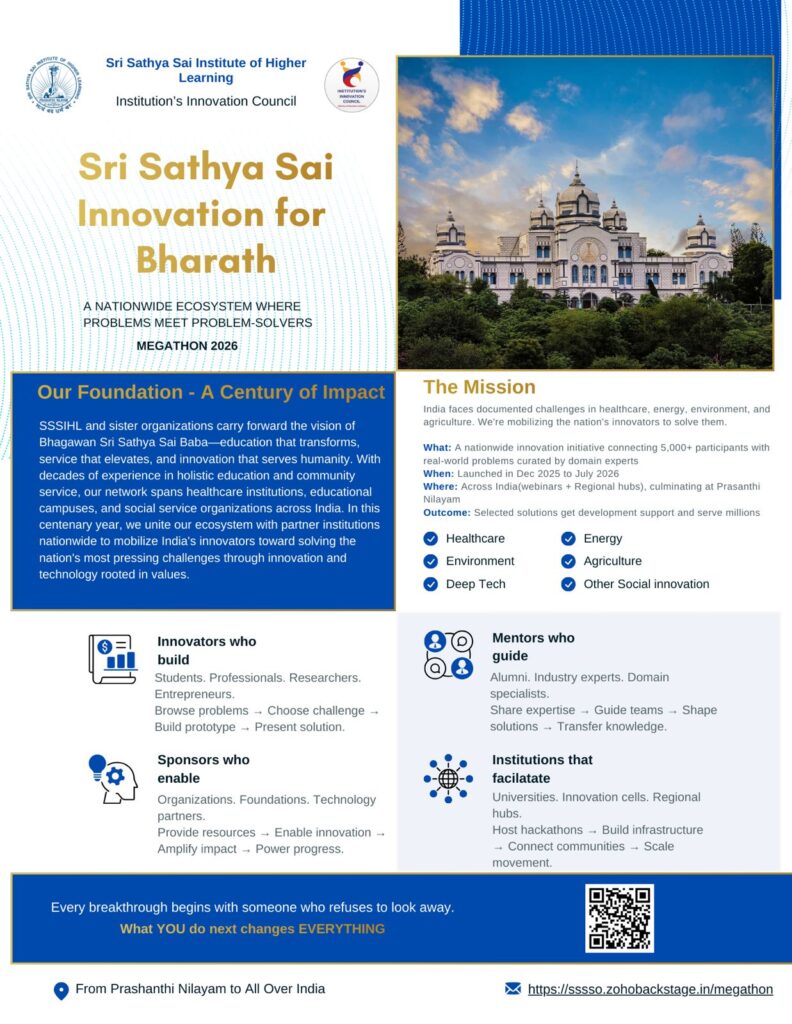
Want to Be Part of India’s Next Big Innovation Movement?
Join Sri Sathya Sai Innovation for Bharat – MEGATHON 2026, a nationwide platform bringing together innovators, mentors, and knowledge partners to solve real-world challenges.
Focus Areas: Healthcare | Energy | Environment | Agriculture | Deep Tech
🗓 December 2025 – June 2026
⭐ 100% Free Registration (All Categories)
More than a competition—this is innovation with purpose.
👉 Register here:
https://sssso.zohobackstage.in/megathon
📩 Queries: [email protected]
Megathon SSSIHL Innovation